Year End Tax Planning for Practice Owners

January 01, 2026

Happy Holidays! As the year comes to a close, it's the perfect time to double check you're taken advantage of all the tax tools at your disposal. Here' are a few easy ones to knock out this coming week:


Reimburse home office expenses

If you use the words “home office deduction,” an accountant they’ll likely tell you that is a major audit target. But using a reimbursement system is a strategy most accountants I work with are okay with. Essentially what you do is calculate the % of your home that belongs to your dedicated home office space (read: not your kids play room/guest bedroom/wine room), add up all your home expenses and apply that % to your expenses.


Power Bill: $6,000

Water Bill: $3,000

Gas Bill: $1,200

Insurance: $1,800

Total: $12,000 x 10% (sq ft of office as % of home) =   $1,200 reimbursement


Then the practice writes a check to your personal for those expenses and it is categorized.


Maximize your 401k or Simple IRA

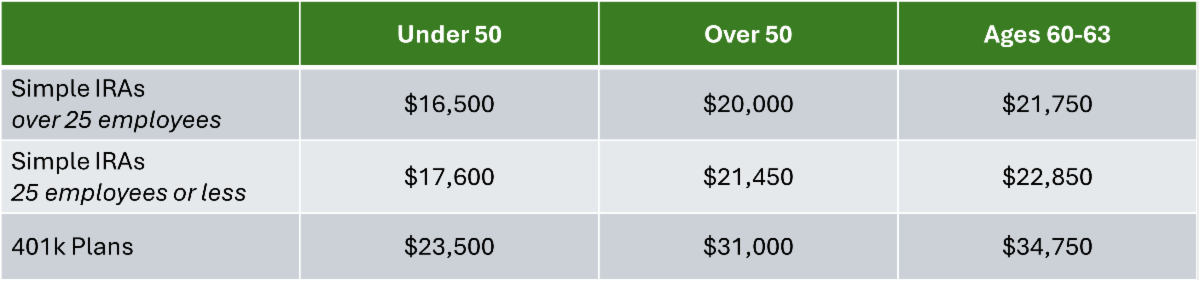
This may sound unnecessary, but a lot of times owners change their pay throughout the year, which can affect maxing out a Simple IRA or 401k. Double check your contributions year-to-date to make sure you’re on track to fully fund your retirement account. This easiest way to do this is check your contribution for the year after the last paycheck of the year has run then post a bonus check deferring 100% to your plan. There are some new rules this year, so 2025 contribution limits are below:

Just a quick reminder that in 2026 catch-up contributions are required to be Roth not pre-tax.


Tax Loss Harvesting/ Gains Management      

If you're an index investor its unlikely you have any losses to harvest this year but if you like picking individual stocks you may have some in a taxable investment account (an IRA or 401k won't help you). The limit of any single loss with no gain to offset is $3,500 in any given year, but if you have a gain you want to take (again in a taxable account), the sky's the limit on using long term losses to offset long term gains (or short term losses to offset short term gains). Just beware- if you sell at a loss you need to wait 30 days before re-buying or the IRS will negate your the losses.


Got gains? If you're charitably inclined, donating long-term (held more than one year) low basis stock (again in a taxable account) to a qualified non-profit or donor advised fund gets you both an income tax deduction and ability to not incur gains if it was something you wanted to sell anyways- charitable contributions don't negate wash sale rules if you want to rebuy right away. Be sure to keep your cost basis and purchase date information for your accountant- they're going to want it.


Have a year-end tax call with your CPA and make your safe harbor and state tax payments

Over the last decade, not making safe harbor tax payments has not been a big issue as IRS interest rates were super low. But the last few years are a different story. In January of 2026 the penalty for underpayments is 7% compounding daily. It’s not the end of the world if you’re off by a few hundred dollars but it you miss the mark by tens of thousands of dollars it can start to get expensive.


Safe harbor payments are 100% of your 2025 tax bill or 110% of your 2024 tax bill. Generally 110% of a prior year tax bill is an easy way to stay in good graces with the IRS, but if you had a large capital gain, practice sale or any other unusual event in 2024 it’s best to calculate your 2025 bill out before the end of the year.


Instructions on making estimated tax payments coming early January- reminder your 4th quarter payment is due 1/15.


If you're seriously behind on estimated tax payments, make a quick bonus check to yourself withholding everything for taxes. I want to be clear this strategy is a last minute fix and incurs unnecessary payroll taxes that using an estimated tax payment strategy does not.


Some but not all accountants use the SALT (state and local tax) deduction or PTE (pass through entity) deduction, which allows you to deduct your state and local income tax bill on your federal return. That check needs to be postmarked by 12/31 (or earlier based on the state). Consult your accountant on this one.


Things you don't need to worry about this year

Not everything has to be last minute. Here are a list of things that just needed to be funded by tax time, not 2025:


  • Traditional and Roth IRAs including contributions for backdoor Roths- just make sure your custodian marks it correctly for 2025 not 2026
  • HSA contributions- again just make sure it's noted for 2025
  • SEP contributions are always done after the end of the calendar year. If you have no other retirement plan set up this is an option post year-end to see if it makes sense for you


Happy year end tax planning and have a wonderful holiday season!


Natalie

P.S.- Hayes Wealth Advisors works exclusively with Optometric Practice owners to help them build wealth outside their practices through customized, industry-specific planning. We have built planning tools to comprehensively answer the questions that face practice owners in today's environment. Our services are available both on a one-off basis or in the context of a full financial plan. Set up a call if you'd like to learn more about how Hayes Wealth Advisors can help you make the best financial decisions for your practice and family.

Helping ODs Build Wealth Outside Their Practice
Natalie Hayes Schmook, MBA
Certified Financial Planner™
Certified Valuation Analyst™
Certified Exit Planning Advisor
www.hayeswealthadvisors.com
natalie@hayeswealthadvisors.com
(404) 954-1133
Hayes Wealth Advisors provides financial planning through a Comprehensive Personal Wealth Action Plan and long term, customized investment management services. Our goal is to help optometrists to build wealth outside their practice in such a way that they are able to live life to their fullest regardless of market conditions.
FOR EDUCATIONAL AND INFORMATIONAL PURPOSES ONLY.
The views expressed here are as of the date of publication and are subject to change. This information should not be construed as investment advice. It is presented for information purposes only and is not intended to be either a specific offer (or recommendation) Hayes Wealth Advisors to sell or provide, or a specific invitation for any investor. Information herein may have been obtained from sources believed to be reliable, Hayes Wealth Advisors is unable to warrant its accuracy.
All data, projections and opinions are as of the date of this report and subject to change.
Investing involves risk, including the possible loss of principal. Past performance is no guarantee of future results.
Hayes Wealth Advisors does not provide legal, tax or accounting advice. You should consult your legal and/or tax advisors before making any financial decisions. All recommendations must be considered in the context of an individual investor’s goals, time horizon, liquidity needs and risk tolerance. Not all recommendations will be suitable for all investors.
Investments have varying degrees of risk. Some of the risks involved with equity securities include the possibility that the value of the stocks may fluctuate in response to events specific to the companies or markets, as well as economic, political or social events in the U.S. or abroad. Bonds are subject to interest rate, inflation and credit risks. Treasury bills are less volatile than longer-term fixed income securities and are guaranteed as to timely payment of principal and interest by the U.S. government. Investments in foreign securities (including ADRs) involve special risks, including foreign currency risk and the possibility of substantial volatility due to adverse political, economic or other developments. These risks are magnified for investments made in emerging markets. Investments in a certain industry or sector may pose additional risk due to lack of diversification and sector concentration.