Year End Tax Planning for Practice Owners

November 23, 2026

I'm surely not the only one wondering how it's already Thanksgiving week. It's hard to believe we're almost to 2027! That being said, there's just a little over a month until the end of the year, so (at one of my favorite clients' request) I wanted to send a year-end tax planning reminder.

Reimburse home office expenses

If you say the words "home office deduction" to an accountant, they'll likely tell you it's a major audit target. But a reimbursement system is a strategy most of the accountants I work with are okay with.

Here's how it works: figure out what percentage of your home is your dedicated home office space (read: not your kids' playroom/guest bedroom/wine room), add up all your home expenses, and apply that percentage to them.

Expense Amount

Power bill $6,000

Water bill $3,000

Gas bill $1,200

Insurance $1,800

Total $12,000

$12,000 x 10% (office sq ft as a % of your home) = $1,200 reimbursement

Then the practice writes a check to your personal account for those expenses and books it as a reimbursement, not as wages.

Maximize your 401(k) or SIMPLE IRA

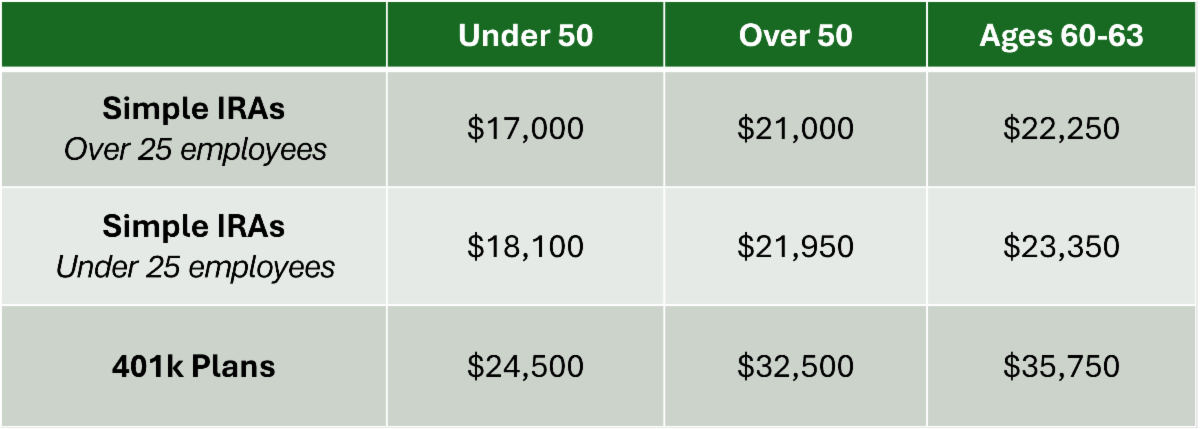
This may sound unnecessary, but owners often change their pay during the year, and that can throw off how much goes into a SIMPLE IRA or 401(k). Double-check your year-to-date contributions to make sure you're on track to fully fund your retirement account. The easiest way to do this is to check your total after the last regular paycheck of the year has run. If you're short, run a bonus check and defer as much of it as you need into your plan. There are some new rules this year, so here are the 2026 contribution limits:

Tax Loss Harvesting / Gains Management

I had to edit this paragraph from last year after last week's stock market performance! It was ugly out there, but this is a good time to take a peek at your taxable investment accounts. If you have any losses in your portfolio, you may be able to sell them to offset gains from trimming big positions. (I'd glance at fixed income/bond holdings first.)

Just beware: if you sell at a loss, you need to wait 30 days before re-buying (and you can't have bought it in the 30 days before the sale either), or the IRS will disallow the loss for now.

Have a year-end tax call with your CPA and make your safe harbor and state tax payments

Over the last decade, missing safe harbor tax payments wasn't a big deal because IRS interest rates were super low. The last few years are a different story. Right now, the IRS underpayment rate is 7%. It's not the end of the world if you're off by a few hundred dollars, but if you miss the mark by tens of thousands of dollars, it can start to get expensive.

To hit safe harbor, pay in either 90% of your 2026 tax bill or 110% of your 2025 tax bill (100% if your 2025 AGI was $150,000 or less). Paying 110% of last year's bill is usually an easy way to stay in good graces with the IRS. But if you had a large capital gain, a practice sale, or any other unusual event in 2025, it's best to work out your 2026 bill before the end of the year.

Instructions for making estimated tax payments are coming in early January. Your 4th quarter payment is due 1/15.

If you're seriously behind on estimated payments, a quick fix is to pay yourself a bonus and withhold all of it for taxes. The IRS treats withholding as if it were paid evenly through the year. To be clear, this is a last-minute fix, and it comes with payroll taxes you wouldn't owe with estimated payments.

Many states offer a PTE (pass-through entity) tax election. It's a workaround to the SALT (state and local tax) deduction cap: your business pays your state income tax, and that payment is deducted on your federal return. Some accountants use it and some don't. If you're using it, the payment generally has to be made by 12/31 (or earlier, depending on your state). Check with your accountant on this one.

Things you don't need to worry about this year

Not everything has to be done at the last minute. Here's a list of things that need to be funded by tax time, not by December 31:

  • Traditional and Roth IRAs, including contributions for backdoor Roths. Just make sure your custodian marks them for 2026, not 2027.
  • HSA contributions. Again, just make sure they're marked for 2026.
  • SEP contributions are usually made after year-end. They can go in any time up to your tax filing deadline, including extensions. If you have no other retirement plan set up, this is an option to look at after year-end to see if it makes sense for you.

Happy year-end tax planning, and have a wonderful Thanksgiving!

Natalie

P.S.- Hayes Wealth Advisors works exclusively with Optometric Practice owners to help them build wealth outside their practices through customized, industry-specific planning. We have built planning tools to comprehensively answer the questions that face practice owners in today's environment. Our services are available both on a one-off basis or in the context of a full financial plan. Set up a call if you'd like to learn more about how Hayes Wealth Advisors can help you make the best financial decisions for your practice and family.

Helping ODs Build Wealth Outside Their Practice
Natalie Hayes Schmook, MBA
Certified Financial Planner™
Certified Valuation Analyst™
Certified Exit Planning Advisor
(404) 954-1133
Hayes Wealth Advisors provides financial planning through a Comprehensive Personal Wealth Action Plan and long term, customized investment management services. Our goal is to help optometrists to build wealth outside their practice in such a way that they are able to live life to their fullest regardless of market conditions.
FOR EDUCATIONAL AND INFORMATIONAL PURPOSES ONLY.
The views expressed here are as of the date of publication and are subject to change. This information should not be construed as investment advice. It is presented for information purposes only and is not intended to be either a specific offer (or recommendation) Hayes Wealth Advisors to sell or provide, or a specific invitation for any investor. Information herein may have been obtained from sources believed to be reliable, Hayes Wealth Advisors is unable to warrant its accuracy.
All data, projections and opinions are as of the date of this report and subject to change.
Investing involves risk, including the possible loss of principal. Past performance is no guarantee of future results.
Hayes Wealth Advisors does not provide legal, tax or accounting advice. You should consult your legal and/or tax advisors before making any financial decisions. All recommendations must be considered in the context of an individual investor’s goals, time horizon, liquidity needs and risk tolerance. Not all recommendations will be suitable for all investors.
Investments have varying degrees of risk. Some of the risks involved with equity securities include the possibility that the value of the stocks may fluctuate in response to events specific to the companies or markets, as well as economic, political or social events in the U.S. or abroad. Bonds are subject to interest rate, inflation and credit risks. Treasury bills are less volatile than longer-term fixed income securities and are guaranteed as to timely payment of principal and interest by the U.S. government. Investments in foreign securities (including ADRs) involve special risks, including foreign currency risk and the possibility of substantial volatility due to adverse political, economic or other developments. These risks are magnified for investments made in emerging markets. Investments in a certain industry or sector may pose additional risk due to lack of diversification and sector concentration.